Tuesday, May 31, 2016

Hospital Sisters of St. Francis: Springfield, IL

On Saturday and Sunday of Memorial Day weekend, I got an opportunity to visit with the Franciscan friars in Springfield, IL.  The friary is on the grounds of the Hospital Sisters of St. Francis.  This is where the sisters have their motherhouse, retirement center, and the Chiara Center, a retreat facility that is much-appreciated by those who have been there.  Here are a few photos:

The statue in the cemetery reminds me of an experience
 in Assisi back in  1995.  I was looking for a statue of
Francis with the wolf of Gubbio for one of my sisters, and the
owner of the store showed me a small statue similar to this one
and then tried to convince me that the animal was really a wolf--
it just looked like a sheep.


There were several cemetery areas.  It made me think about all
the sisters who had dedicated their lives to caring for the sick.  How
many people living today are descendants of ancestors whose
lives were saved through the ministrations of the sisters?

Entrance to the Chiara Center

Entrance to the main church


Tuesday, May 17, 2016

Advice from St. Clare (2nd Letter to Blessed Agnes of Prague)

Here are words of advice offered by Clare to Agnes.  The centuries have not weakened the power of that advice:

What you hold, may you continue to hold, 
what you do, may you keep doing and not stop,  
but with swift pace, nimble step, and feet that do not stumble 
so that even your walking does not raise any dust, 
may you go forward tranquilly, joyfully, briskly, and cautiously 
along the path of happiness,  
trusting in no one and agreeing with no one 
insofar as he might want to dissuade you 
from pursuing your founding purpose 
or might place a stumbling block in your way, 
preventing you, in that perfection 
with which the Spirit of the Lord has called you, 
from fulfilling your vows to the Most High.


Monday, May 9, 2016

Franciscans in Northern Wisconsin: Ashland, the Early Years

While the friars of the Province are familiar with it, not many others know about the book Heralds of the King by Fr. Marion Habig, OFM.  The book, published by the now-defunct Franciscan Herald Press, was compiled to celebrate the centennial anniversary of the friars' arrival from Germany.  It is a history of the Province up until 1958, and records many of the significant events and pioneer friars who helped make us who we are today.  I hope to publish occasional excerpts from Heralds of the King to help others appreciate the work of the friars who came before us.

Here is an excerpt concerning my hometown of Ashland, WI.  The church, while I was growing up, was placed under the patronage of St. Agnes.  When Holy Family Parish and St. Agnes were combined, the name was changed to Our Lady of the Lake.


St. Francis  Friary  and  Parish  in Ashland

The first settlers came to Ashland in 1854; but, as in the case of Superior, the town began to decline in 1857, and two years later only one family remained. Some of the former settlers returned in 1872, but in 1878 when Father Verwyst first visited Ashland it was only a poor hamlet with a few dozen houses. At that time it was served by only one railroad, the Wisconsin Central. By 1904, three other lines, the Northern Pacific, the Chicago and Northwestern, and the Omaha Railroad, came into Ashland; and the city had several large ore and coal docks, saw mills, blast furnaces, and other manufacturing establishments.

In 1855, Father Augustine Benoit offered up holy Mass for the first time in Ashland in an Indian wigwam; and from 1872 to 1878, Fathers Quigley and Schuettelhofer held divine services there occasionally. When the Franciscans came to Bayfield in 1878, Ashland became one of their mission stations. At that time there ,were 25 Indian and White families in the town who were Catholics. 

A small church which had been begun by Father Schuettelhofer in 1874 was completed by Father Casimir in 1879.  The following year he added a belfry. In 1882, Father Eustace Vollmer built an addition to the church, 22 by 30 feet, and added  a small room in the rear for the use of the priest. The latter was so small that two single bedsteads filled all the available space. Before this room was built, the visiting missionary friar often spent the night in a small, partially open compartment in the belfry, surrounded by sleeping birds and flying bats. A school was opened at Ashland in 1883.

By 1886 the parish in Ashland had grown to such an extent, that  the building of a new church of brown sandstone and a brick veneered residence was commenced. The latter was completed the same year and erected into a separate friary. The work  on  the  church, however, progressed rather slowly, since the contractor proved to be inefficient. A part  of  the wall,  being  out  of plumb, had to be torn down and rebuilt; and a part of the steeple collapsed. The work was then placed in the hands of a capable contractor;  and  in  1887 the church  was  roofed  and  its  basement was made ready. The basement was then used  for divine services while the upper part of the church was being completed.  Finally in  1888  the church was dedicated under the patronage of St. Agnes.

The teachers of the parish school are Franciscan Sisters of Perpetual Adoration, who also founded an academy for girls. By  1904 the school was attended by 810 children, and the parish comprised about 640 families or 3,000 souls. It was a truly cosmopolitan parish, and in the course of time included Poles, Irish, Germans, Scotch, Bohemians, Lithuanians, English, Italians, Belgians, French, and Indians.  A new high school, called DePadua High School, was blessed, January 5, 1930.

Before 1904 the Poles had been  organized  into  a  separate  parish,  which in that year comprised about 1,500 souls and had 215 children attending its school. Since  the  number  of  Polish  families  was  increasing steadily, they had begun  already  in  1889  to  organize  themselves  with  a  view  to forming  a  separate  parish.  In  May,  1893, separate services for the Poles began to be held once a month in the basement of St. Agnes Church.  From about  1895  these  services  were  held  every   other   Sunday   and  on  holy   days   of   obligation.  


 Ground for a church and  school  of  their  own  was  purchased  in  1899  three blocks distant from St. Agnes Church; and in the fall of  the  following year, the school  and  the  basement  walls  of  the  church  were  built.  Holy  Mass  was celebrated  for  the  first  time  in  the  basement  on January 26, 1902, the feast  of  the  Holy  Family,  under  whose  patronage the church was to be dedicated.  The dedication took place on September  28  of  the  same year. The church  is  a  brick  structure,  128 by 54 feet, and cost $30,000. One of  the Franciscans  residing  at  St.  Agnes Friary is  the  pastor  of  this  parish.  And the  teachers  in  the  school are Franciscan Sisters of LaCrosse, Wisconsin.


Thursday, May 5, 2016

Franciscans in Africa: Article on the Year of Mercy Project

The St. Louis Review (the archdiocesan newspaper) has an article about the Sacred Heart Province's Year of Mercy project in the current edition.  To see the article, use this link:

St. Louis Review article

If you would, please pass this information along to your various contacts.  Thanks!

Peace and every good,
Fr. John Eaton, OFM
Director, Franciscan Charities

Monday, April 25, 2016

Sweet Holy Spirit: Annual Revival, St. Augustine of Hippo, East St. Louis, IL

St. Augustine Parish in East St. Louis, IL, recently celebrated their annual revival.  This year's revival preacher was Fr. Maurice Nutt, C.Ss.R.

Father Nutt is currently a member of the Redemptorist Parish Mission Preaching Team based in Chicago, IL.  Additionally he is a member of the faculty of the Institute for Black Catholic Studies at Xavier University of Louisiana, New Orleans, where he teaches Preaching.  He has written three books:  Thea Bowman:  In My Own Words, Advent and Christmas Wisdom from St. Alphonsus Liguori, and Lent and Easter Wisdom from St. Alphonsus Liguori.  Father Nutt is also a contributor to the African American Catholic Youth Bible, a collaborative project between the National Black Catholic Congress and St. Mary’s Press.  He has also published many articles about preaching, evangelization and stewardship.

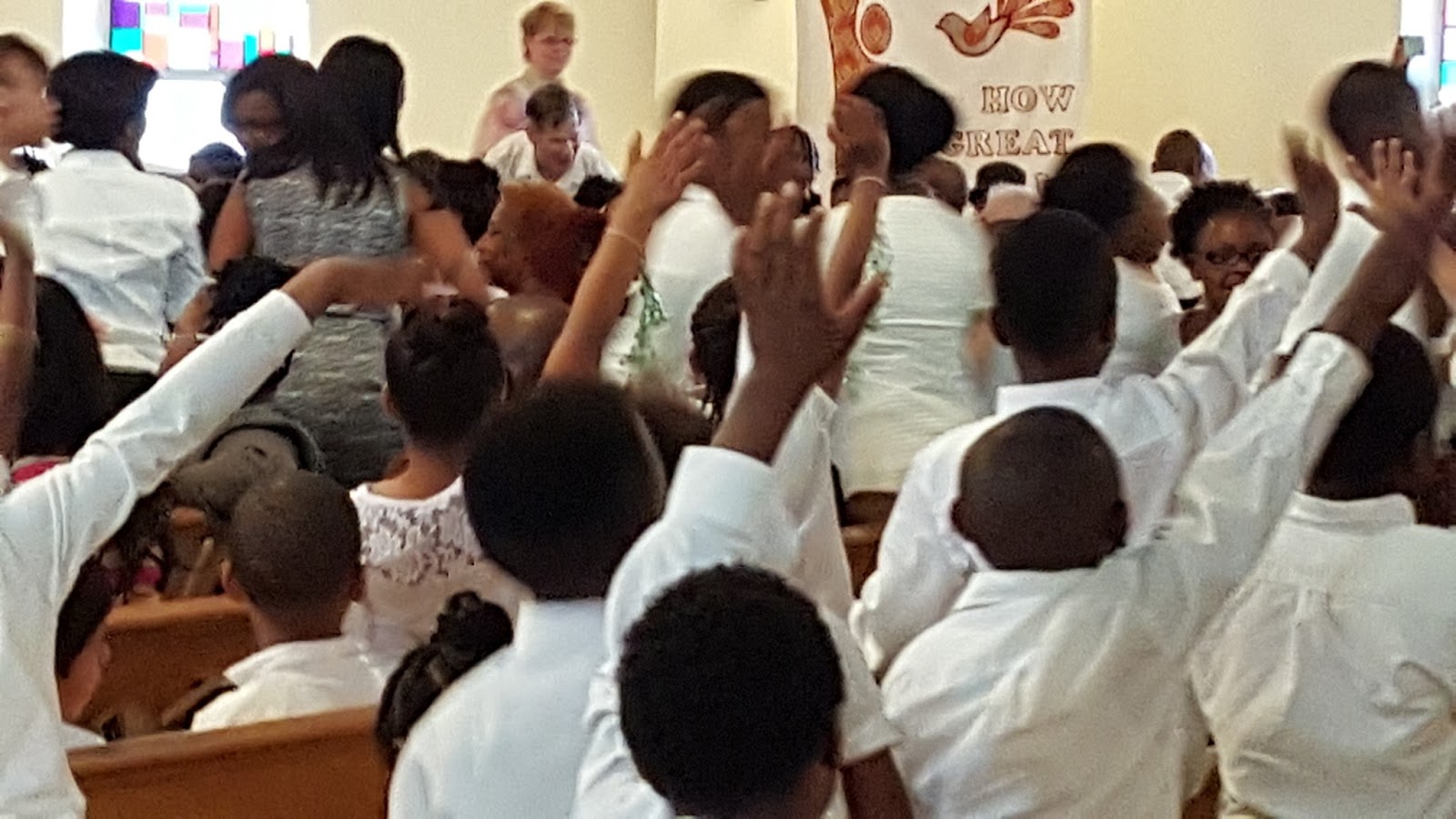
For the closing evening of the revival, the choir from St. Alphonsus Parish (aka, the Rock) in St. Louis helped provide the music.  The youth choir from St. Augustine also did a wonderful job as did the Praise Dancers.  Here are some photos:

Fr. Maurice Nutt


The St. Augustine Praise Dancers

Choir from "The Rock" Catholic Church in St. Louis

Sr. Thea Bowman Catholic School: Spring Concert

Sr. Thea Bowman School is the only Catholic grade school in East St. Louis, IL. My brother, Br. Tom Eaton, OFM, teaches religion and computer classes there.

The school curriculum is unusual in that it features music and dance components. All the students from kindergarten through 8th grade receive violin lessons. All the students learn the elements of dance, and the older students receive additional lessons in ballroom dancing. Here are some photos from the spring concert on April 24.

The school is doing a great job with limited financial resources and recurring problems with the physical plant (roof, windows, etc.) If you would like to make a donation or receive more information about how you can help, please contact Roberta Trost at 618-397-0316.


Wednesday, April 13, 2016

Franciscans in Asia: Friar Jeff Haller, OFM

Sacred Heart Province recently received the following report from Fr. Jeff Haller, OFM.

LENT AND HOLY WEEK IN MYANMAR (BURMA)

I just returned from a month of teaching in Yangon, the largest city and former capital of Myanmar (Burma).  Last year the friars of the Myanmar (OFM) Foundation and the FMM (Franciscan Missionaries of Mary) in Myanmar decided to collaborate in organizing a teaching program---which will perhaps develop into an institute---open to the public. Since we had a break in our academic year in Thailand, and the Minister General encouraged us in Thailand to seek closer collaboration with our brothers in Myanmar, I offered to help them in their program during the brief period I was available. Most of the students were of university-age or close to it. 

What struck me as commendable, in addition to the educational assistance in English that was being given, was the way that Christians, Buddhists and Muslims were coming together with mutual respect to further their education. We teachers were all friars and sisters of St Francis, but we made the classes very inclusive to those who came through the door.  In addition to the different religious identities represented, we had a variety of Myanmar’s ethnic identities: those who were of the majority Burmese population, but also those who were of Tamil and Telugu backgrounds (India) and some from the Myanmar states of Chin, Mandalay, Kachin, Kayin, and Shan.

One of the benefits of being in Yangon at this time was the opportunity to celebrate Holy Week with the Burmese.  Probably the highlight for me was to attend Easter morning mass at the cathedral in Yangon’s city center; the celebrant was Cardinal Charles Bo, who last year made history for the Church in being named Myanmar’s first cardinal ever. [ Catholic new sources state:  “Bo's appointment as Myanmar's first cardinal is seen as support for his efforts to push national reconciliation, peace, justice and freedom as his people struggle with religious and ethnic tensions and other problems.”] 

Cardinal Bo gave a homily which probably would have been unthinkable even 5 years ago. He cited some of the problems that have plagued the nation in the past and kept it in a “crucified” state.  Not surprisingly, he mentioned Aung San Suu Kyi and the obstacles she has had to overcome to reach her current role in the new government (which became empowered on March 30---the first civilian-elected government in 50 years). He also included Martin Luther King and Barack Obama among the persons who represent hope over oppression.  I was able to chat briefly with Cardinal Bo after mass and thanked him for the very upbeat tone of “resurrection” he shared with the congregation;  Easter as it should be!     

  --Jeff Haller, ofm


[Article appeared in the Sacred Heart Province ATP April 12, 2016]


Displaying Cardinal Charles Bo Easter Day  2016.JPG

Franciscans in Africa: Fr. Damien Isabell, OFM

Fr. Damien Isabell has been serving in the Democratic Republic of Congo (formerly Zaire) for over 30 years. Besides teaching in the local Franciscan seminary, he has also taken on the job of housing, feeding, and providing education and technical training for some of the homeless boys in the area.  The last I heard, there were 27 boys in his care.

Fr. Damien recently sent some photos.  Since the DRC does not have a celebration comparable to the USA's Thanksgiving day, the boys designed their own thanksgiving celebration.  The local bishop and some Third Order members came to join in the festivities.  Fr. Damien's note indicated that when the kids started dancing, others in the area joined in.

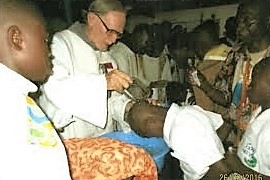
Also, Fr. Damien got the rare privilege of being invited to baptize some of the boys during the Easter celebration.  Here are some of the pictures we received.

To make a donation to support Fr. Damien's work in the DRC, please contact Br. Joseph Rogenski, FMU, 3140 Meramec St., St. Louis, MO, 63118.  If you wish to donate online, please click on this link which will take you to the Franciscan Charities webpage:  Franciscan Charities


Tuesday, April 12, 2016

Extension Society Lumen Christi Awards

Every year, the Extension Society recognizes a Church minister to receive the Lumen Christi award.  This year there is a long list of nominees.  I was pleasantly surprised to see Sr. Phyllis Wilhelm on the list.  Sr. Phyllis is a Joliet Franciscan.  She and I worked together in Bayfield, WI, where she was responsible for ministry and catechesis on the Red Cliff (Ojibway) Reservation.  Sr. Phyllis has dedicated a significant portion of her religious life ministering in the Native American community.

To see the list of nominees and to read Sr. Phyllis' and others' summaries, please click on this link.

Lumen Christi Nominees

Kevin Delgado

Thursday, March 24, 2016

Quincy, IL: One of USA Today's top college towns

In case you missed it, Quincy, IL, was ranked #19 on USA Today's list of the 25 top college towns in the country.  In part, here's what was written:

Although its population isn’t as young, on average, as most of the other cities in our analysis, Quincy made the cut by largely by virtue of its low rent prices, which gave it a rent-to-earnings rank of fourth. It also ranked 13th for bars, with more than four per 10,000 residents. Located along the Mississippi River, Quincy gives residents plenty of options for things to do, including local museums, historical architecture and access to the Mississippi Valley Wine Trail. Quincy University, founded in 1860 by Franciscan Friars, today opens its doors to students of all faiths and enrolls around 1,500 students.
As a Wisconsin native, I should also point out that LaCrosse and Appleton made the list at #7 and #8 respectively.

I'm not sure why the number of bars plays into the ranking.

Monday, March 14, 2016

Franciscans in Alaska

A recent news article concerns a snowmobiler who hit and killed a sled dog during the famed Iditarod race.  The incident took place near Nulato, Alaska--where one of our friars, Br. Bobby Joe Ruzicka, is currently serving as the director of pastoral ministry.

After serving as a cook in Quincy and St. Louis and then as the Provincial Director of Vocation Promotion, Bobby Joe was among the first friars to go to the Diocese of Fairbanks in 1986.

Fr. Joe Hemmer was active in our education ministry from 1956 - 1979.  He then served as pastor of St. Jude Parish in Cleveland before spending a year doing campus ministry at Quincy (IL) University.  Fr. Joe came to Alaska in 1988 and is currently serving at Kaltag and Ruby.  Getting pretty close to 90 years old, Fr. Joe has enjoyed relatively good health for most of his life.  More recently, however, he has been battling cancer and some eye problems.

Br. Justin Huber is one of those men who can fix anything.  He worked at the brothers' school in Oak Brook, IL, from 1967 - 1980 before spending 10 years as a missionary in Zaire.  Back in the States, Br. Justin served as a technical consultant at Padua High School (Parma, OH) and then headed the maintenance staff in St. Francis Village in Crowley, TX.  From 1995 - 2000, he joined Fr. Tom Vos in the Franciscan Mountain Ministries in northeast TN.  Justin went to Alaska in 2000 and is currently living in Galena.

These three friars were nominated to receive the Extension Society's Lumen Christi award in 2014.  Here's a link to an article about them:

Franciscans in AL

Other friars from Sacred Heart Province have made the trek to the Fairbanks diocese in order to provide assistance as needed.

To support the friar missionaries in Alaska, please contact Br. Joe Rogenski at the Franciscan Missionary Union at 314-655-0547.  To donate online, please find us at franciscancharities.org.

Friday, March 11, 2016

Franciscans in Prison Ministry: Fr. Christian Reuter, OFM

During this Year of Mercy, we remember that one of the Corporal Works of Mercy is to "visit the imprisoned."  I received a recent e-mail from a long-time friend, Martin A. Berg, which provided links to a wide spectrum of information on prison ministry.  Marty went on to say that he felt that prisoners were population most underserved by the Church.

Fr. Christian Reuter (whom I live with in East St. Louis) is the coordinator of prison ministry for the Diocese of Belleville.  On March 9, he and his associates were in Joliet, IL, to give a presentation to about 70 people interested in prison ministry.  The presentation was based on the dynamics of the Easter Vigil and was so named: "This Is the Night When Christ Broke the Prison Bars of Death."

Here is Chris' summary of the presentation:

The program was entitled: "This Is the Night When Christ Broke the Prison Bars of Death", a quote taken directly from the Easter Proclamation. It was loosely modeled on the liturgical structure of the Holy Saturday Vigil. I did the oral presentation from notes while the Power Point slides were projected on a large screen. We also used a Paschal candle, water sprinkling, and a number of musical selections.

In the first half ("Light the Fire" and "Tell the Story"), the goal was to get the participants to understand how criminal justice, which the U.S. bishops have labeled "a broken system", got into such a dark night. This entailed a look at incarceration through long ages of civil and church history. The second half ("Sign Me Up" and "Open the Door"), invited participants to renew their baptismal promises in a creative way and to consider how they might offer themselves in some form of criminal justice ministry--either in Justice Advocacy or in Pastoral Care.

I was assisted in the oral presentation by two eloquent "witnesses". In the first half, a former prisoner who had spent twelve years in solitary confinement gave a riveting description of what that does to an incarcerated person. In the second half Lou Slapshak, who is my "Co-Coordinator" of Prison Ministry in the Belleville Diocese, spoke of his calling to lay ministry and how that has radically changed his life. The program ended with "Open the Door of Mercy," an original composition from Immaculate Conception Parish in Columbia IL. The song's composers (Karen Lundy and Marybeth Babcock) journeyed all the way to Joliet to teach and conduct the commissioning song that concluded the evening.

Anyone seeking more information can contact me by email (cnreuter@yahoo.com). Also, the website of our developing reentry house (www.obkministry.org) contains a wealth of content and links on Catholic prison ministries.


Fr. Chris and his committee are actively working to found a "reentry" house to help ex-convicts to transition back into the larger society.  Chris has given the website above; donations are welcomed.

Monday, February 22, 2016

What in the World Are the Friars up to? (Vietnam, Friar Joseph Tan Doan Nguyen)

Here is a copy of a letter recently sent by Friar Joseph Tan Doan Nguyen.  Friar Joe Tan is a member of the Sacred Heart Province who has returned to his native Vietnam to teach the Franciscan seminarians.  He writes of an interesting--and I would say unexpected--project of the Vietnamese friars.

A Franciscan “Mental Hospice” in Mekong Delta

During the Tet vacation, I had the opportunity to visit a "Mental Hospice" operated by the friars in Can Tho--the capital of Mekong Delta. This area is predominantly Buddhist and Cao Dai (an indigenous religion).  After the fall of South Vietnam (1975), the friars were looking for a place to live because many of their friaries were confiscated and the choices of ministry were rather limited. They came here and eventually established a friary (1999). They give witness to the Gospel of simplicity and joy by reaching out to the poor of the neighborhood as well as the college students at Can Tho University.

One of their recent projects was the Mental Hospice. Built less than a year ago and now holding about 40 patients, the Hospice is served by 1 part-time and 3 full-time friars, along with a couple of local volunteers. The patients come from all over the country. They are either homeless or brought here by relatives. They are divided into 3 levels: those are on the way toward recovery and who eventually can leave or stay at the center to assist others; those unable to make any improvement and must stay here for life; and finally those who need to be isolated due to their mental conditions. Periodically, a volunteer doctor comes in to check the patient’s physical and mental conditions and to prescribe medicines.


The friars’ daily chorus sounds like a “second novitiate”! They cook, feed and bathe the patients. They organize physical and spiritual activity, help the patients to take medicines and most of all, keep them safe. The Hospice survives on the donations from local and out of town benefactors. The friars would go to pick up foods and vegetables whenever the merchants can collect the left-overs in the market. Right now, the Hospice is in need of funds for a water purification system.  Hopefully, with the permission of the Bishop, the friars would like to build a small chapel as the means to evangelize the local population with daily liturgy. They know that their mission and witness must always be accompanied by the local poor.

History repeats itself.  In 1957, responding to the friars’ desire to serve the poor, the Bishop of Long Xuyen Diocese entrusted to them an abandoned seminary in “Cu Lao Gieng” which used to serve both Vietnamese and Cambodian churches during the colonial times.  While providing pastoral ministry for the Providence Sisters next door, the friars also established a Retreat Center, a Formation House for the lay Brothers, a Clinic for Hansen and tropical diseases, and a fishery that is still operating today. A half century later, the call for evangelization has led them to the neighboring Diocese of Can Tho. Now, along with the Hospice project as the base, the friars are reaching out to the Khmer population in nearby province of Tra Vinh, the migrant workers, and the “new poor” in the newly developed industrial areas.

Like the waters of the Mekong Rivers which continue quietly to nourish the land and the people along the Delta over the centuries, the friars have also persisted in following the Gospel of minority and adapting to the changes in the new demographic landscape of South Vietnam.


Thursday, January 28, 2016

St. Francis and Islam

The sometimes difficult relationship between Christians and Muslims brings to mind this story.

In his Major Life of St. Francis, St. Bonaventure  relates how Francis and Br. Illuminatus walked through line of crusaders besieging the Egyptian city of Damietta and were subsequently captured and beaten by the Muslim sentinels.  They were then dragged before Sultan Malik al-Kamil where Francis made his "pitch," inviting the sultan to convert to Christianity.  As the story has been related in other places as well, it seems that the two men conversed respectfully with each other--though neither was able to change the other's mind.

Before providing safe escort back to the Christian army, the sultan offered many gifts to Francis.  The Poverello refused them all--except, it is said, for an ivory horn which had been used to call the Muslims to prayer.  Once back in Italy, Francis would have someone blow that horn when he was preparing to preach.

I was hoping to find some written record of this meeting from the Muslim perspective, but apparently none exists.  I did find this interesting tidbit, though.  Apparently on the tomb of one of Malik al-Kamil's advisers there is an inscription to the effect that: the things which befell al-Kamil on account of the monk are well known.

Stained glass window in St. Francis Church, Teutopolis, IL

Monday, January 18, 2016

St. Francis Describes the Perfect Friar

Here is one of my favorite stories about St. Francis--a story that has given me pause for reflection and material for more than one homily.  Francis is preparing to welcome Sister Death, and the friars around him ask him to name the perfect friar.  This is his response:


A good Friar Minor should imitate the lives and possess the merits of these holy friars: the perfect faith and love of poverty of Brother Bernard; the simplicity and purity of Brother Leo, who was a man of most holy purity; the courtesy of Brother Angelo, who was the first nobleman to enter the Order, and was endowed with all courtesy and kindness; the gracious look and natural good sense of Brother Masseo, together with his noble and devout eloquence; the mind upraised to God, possessed in its highest perfection by Brother Giles; the virtuous and constant prayer of Brother Rufino, who prayed without ceasing, and whose mind was ever fixed on God, whether sleeping or working; the patience of Brother Juniper, who attained the state of perfect patience because he kept the truth of his low estate constantly in mind whose supreme desire was to follow Christ on the way of the Cross; the bodily and spiritual courage of Brother John of Lauds, who in his time had been physically stronger than all men; the charity of Brother Roger, whose whole life and conversation was inspired by fervent charity; the caution of Brother Lucidus, who was unwilling to remain in any place longer than a month, for when he began to like a place, he would at once leave it, saying, ‘Our home is not here, but in heaven.

What are some life lessons that can be drawn from this story?

Disqus for Fr. John Eaton, OFM